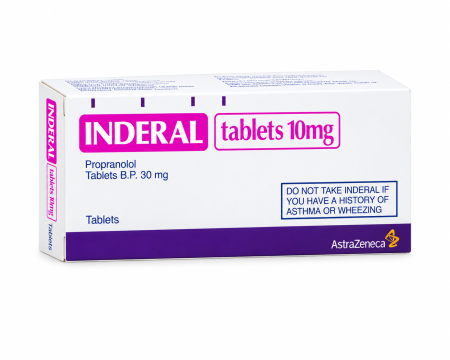
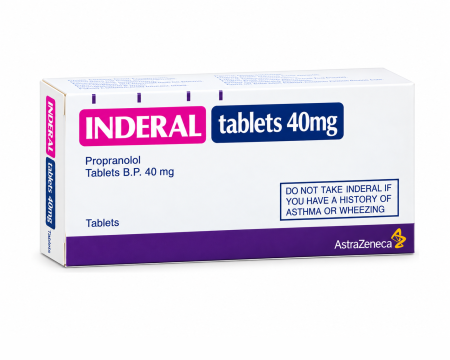


Información sobre el fármaco
- Nombre de la marca: Inderal (también conocido como Sumial en España)
- Ingrediente activo: Clorhidrato de propranolol
- Fabricante: AstraZeneca
Sustancia activa: clorhidrato de propranolol
El propranolol bloquea competitivamente los receptores β1 y β2. Los efectos cardiacos incluyen disminución del ritmo sinusal, enlentecimiento de la conducción AV y menor contractilidad; el bloqueo β1 renal reduce la liberación de renina. El bloqueo β2 periférico reduce la amplitud del temblor y puede contribuir a la profilaxis de la migraña mediante efectos sobre el tono vascular y vías noradrenérgicas centrales.
Es lipofílico, cruza la barrera hematoencefálica y sufre un intenso primer paso hepático; la exposición varía entre individuos. La comida puede aumentar modestamente la biodisponibilidad; tomar las dosis IR en horarios constantes respecto a las comidas favorece una respuesta estable. La semivida es corta con IR, pero las formulaciones ER proporcionan cobertura de 24 horas. Al depurarse principalmente por vía hepática, se requiere cautela en insuficiencia hepática; pueden necesitarse ajustes en pacientes frágiles o con potentes inductores/inhibidores enzimáticos. El bloqueo β2 no selectivo puede provocar broncoespasmo en personas susceptibles: Inderal está contraindicado en asma y debe usarse con precaución en EPOC.
Indications for use
Prescriber-directed uses vary by region and labeling. Common indications include:
- Hypertension (alone or with other antihypertensives)
- Angina pectoris (to reduce frequency of effort-related chest pain)
- Rate control in supraventricular tachycardias (including atrial fibrillation/flutter)
- Migraine prophylaxis (prevention of attacks)
- Essential tremor (symptomatic control)
- Hypertrophic subaortic stenosis (symptom control)
- Pheochromocytoma (adjunct) — only after adequate α-blockade and under specialist care
Use is determined by the clinician according to local guidelines and individual assessment.
Treatment regimens and dosages
Use Inderal exactly as prescribed. Representative adult schedules (the prescriber will tailor doses and targets):
- Hypertension (IR): start 40 mg twice daily, then increase every 1–2 weeks to 80–160 mg twice daily (typical total 160–320 mg/day).
Hypertension (ER): 80 mg once daily, titrate to 120–160 mg once daily (some patients require up to 320 mg/day). - Angina pectoris (IR): 40–80 mg two to three times daily; typical total 120–240 mg/day.
Angina (ER): 80–160 mg once daily, titrate to response. - Rate control in SVT/AF: 10–40 mg three to four times daily (IR) or 80–160 mg once daily (ER) per heart-rate targets and tolerability.
- Migraine prophylaxis: 40 mg twice daily (IR); increase stepwise to 80 mg twice daily (some need up to 160–240 mg/day). ER alternatives (e.g., 80–160 mg once daily) may improve adherence.
- Essential tremor: 40 mg twice daily (IR); titrate to 120–320 mg/day in divided doses based on tremor reduction and tolerability.
- Performance-related situational anxiety (prescriber-directed): 10–40 mg IR, 30–60 minutes before the event; not a chronic regimen.
General rules: take IR tablets in divided doses at consistent times; ER capsules once daily (swallow whole). Do not stop suddenly—taper over 1–2 weeks unless urgent clinical reasons dictate otherwise. In renal impairment, dose adjustment is usually not required; in hepatic impairment, lower initial doses and careful titration are advised.
Recommendations for use
- Track resting and activity heart rate and blood pressure during titration.
- If dizziness or fatigue appears, review dose timing and avoid rapid posture changes.
- Diabetics: Inderal may mask adrenergic symptoms of hypoglycemia (e.g., tremor); maintain regular glucose checks and recognize alternative signs (sweating).
- For migraine: combine with trigger management (regular meals, hydration, sleep hygiene).
- For tremor: limit caffeine/stimulants; note stepwise dose–response.
- Avoid alcohol excess; it can potentiate hypotension and sedation.
Missed Dose
Take the missed dose when remembered unless it is near the next dose. Do not double the next dose. Resume your usual schedule. If multiple doses are missed—especially in angina—contact your clinician for advice on a safe restart.
Precautions
- Respiratory: contraindicated in asthma or history of bronchospasm; use caution in COPD.
- Cardiac conduction/contractility: avoid in severe bradycardia, 2nd/3rd-degree AV block, sick sinus syndrome (without pacemaker), cardiogenic shock, or decompensated heart failure; use cautiously in controlled heart failure.
- Peripheral circulation: may worsen Raynaud’s phenomenon or severe peripheral arterial disease.
- Metabolic: masks hypoglycemia signs; may affect lipid profile (↑TG, ↓HDL) in some patients.
- Thyrotoxicosis: can mask tachycardia—do not withdraw abruptly.
- Anaphylaxis: β-blockers may reduce responsiveness to epinephrine.
- Surgery: anesthetist must know you are on a β-blocker; perioperative plans are individualized.
- Pregnancy/lactation: see below.
- Driving/hazardous tasks: assess individual response—dizziness and fatigue can occur.
Use during pregnancy
Decisions are individualized. Propranolol has been used when benefits outweigh risks (e.g., specific arrhythmias). Potential fetal/neonatal effects include growth restriction, bradycardia, hypoglycemia. If used in late pregnancy, neonatal monitoring is advised. Small amounts pass into breast milk; breastfeeding decisions require clinician guidance with infant observation for bradycardia or poor feeding.
Possible side effects
- Common: bradycardia, cold extremities, fatigue, dizziness, sleep disturbance or vivid dreams, GI upset (nausea, diarrhea).
- Less common: depression or mood change, rash, impotence, bronchospasm (especially in reactive airway disease), hypotension.
- Serious—seek care: syncope, severe shortness of breath, new/worsening chest pain, extreme bradycardia, wheezing in non-asthmatics, signs of heart block.
Document timing, dose relation, and concurrent factors (caffeine, exertion); this helps clinicians adjust dosing or consider alternatives.
Propranolol: interaction with other drugs
- Non-dihydropyridine CCBs (verapamil, diltiazem): risk of bradycardia/AV block/heart failure—avoid IV combinations; oral combinations require specialist oversight.
- Other rate-/BP-lowering agents (digoxin, amiodarone, clonidine, antihypertensives): additive effects; if stopping clonidine, taper propranolol first to reduce rebound risk.
- CYP1A2/2D6 modulators: inhibitors (e.g., fluvoxamine, paroxetine, quinidine) may raise levels; inducers (e.g., smoking, rifampin) may lower levels—dose review may be needed.
- NSAIDs: may reduce antihypertensive effect; monitor BP.
- Hypoglycemics/insulin: altered hypoglycemia awareness—tight glucose monitoring.
- Anesthetics and alcohol: additive hypotension/CNS effects.
Always provide a complete list of prescription/OTC medicines and supplements to your clinician.
Analogs & Generics
Same active ingredient (propranolol — international examples)
- Propranolol IR tablets (Teva, Sandoz/Hexal, Accord/Actavis, Viatris/Mylan) — 10 mg, 40 mg, 80 mg
- Inderal LA / Propranolol ER (various manufacturers) — 60 mg, 80 mg, 120 mg, 160 mg once daily
- Propranolol oral solution (market-dependent) — titration or pediatric needs
Drug analogs (different active ingredient, same therapeutic purpose — examples)
- Hypertension/angina/arrhythmia: Metoprolol, Bisoprolol, Atenolol, Carvedilol, Nebivolol
- Migraine prophylaxis: Metoprolol, Timolol, Topiramate, Amitriptyline (per clinician judgment)
- Essential tremor: Primidone, Topiramate (alternatives/adjuncts where suitable)
Storage
Store at 15–25°C in a dry place away from heat and light. Keep in the original packaging and out of the reach of children. Do not use after the expiry date on the pack.
Customer Experience – What to Expect
For hypertension and angina, many patients notice steadier heart rate and fewer exertional symptoms within 1–2 weeks, with additional gains as the dose is optimized. In migraine prevention, benefits build gradually over 4–8 weeks; attack frequency and intensity decline when taken consistently. With essential tremor, improvement is often perceptible at the first effective dose and refines with careful titration. Early fatigue or cold hands/feet commonly settle after dose timing adjustments. Keeping a simple diary (heart rate/BP, angina episodes, migraine days, tremor severity, side effects) supports precise titration and shared decisions.
FAQ
¿Qué tan rápido empieza a actuar Inderal?
Los efectos sobre frecuencia y presión aparecen en horas; los beneficios clínicos (p. ej., menos angina, prevención de migraña) se acumulan en días a semanas.
¿Puedo tomar Inderal si tengo asma?
No: está contraindicado por riesgo de broncoespasmo. Consulte alternativas.
¿Qué pasa si lo dejo de golpe?
La retirada brusca puede causar taquicardia, hipertensión o angina de rebote. Reduzca gradualmente bajo supervisión médica.
¿Afecta a la percepción de hipoglucemia?
Sí: puede enmascarar síntomas como el temblor. Controle la glucosa y aprenda señales alternativas.
¿IR o ER — qué es mejor?
Ambas son eficaces. ER ofrece comodidad de una toma diaria y cobertura estable; IR permite titulación flexible. Su médico elegirá según indicación y estilo de vida.
¿Sirve para el “miedo escénico”?
Algunos médicos usan dosis IR pequeñas (p. ej., 10–40 mg antes del evento). Es un uso pautado y no crónico.
La mejor oferta en línea para Inderal
Ahora puede comprar Inderal en nuestra farmacia en línea. Si busca el mejor lugar para pedir Inderal u otros medicamentos con propranolol, está en el sitio correcto.
Ventajas de nuestra farmacia:
- Confidencialidad. La mayoría prefiere mantener en privado el tratamiento cardiovascular/neurológico. Al pedir Inderal en línea, evita conversaciones presenciales innecesarias.
- Precio. Comprar Inderal en línea suele ser más ventajoso que en clínica o farmacia local.
- Cantidad. Los médicos suelen recetar uno o dos envases. Nuestra farmacia le permite pedir la cantidad necesaria para asegurar el suministro.
- Comodidad. Compra cuando le convenga, sin sacrificar servicio ni seguridad. No necesita cita ni desplazamientos.
- Información. En nuestro sitio encontrará detalles sobre dosis, efectos adversos, uso seguro y otros datos necesarios para el tratamiento.
Trabajamos para ofrecer el mejor servicio posible y para que nuestros medicamentos ayuden a controlar la frecuencia cardiaca y la presión arterial, prevenir migrañas y reducir el temblor bajo supervisión médica.