

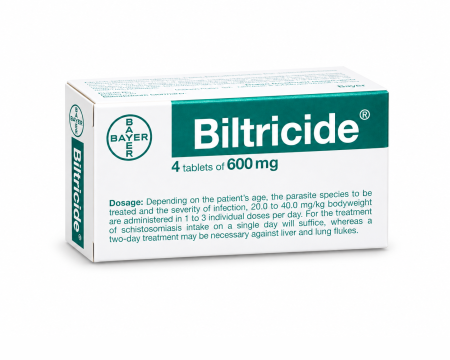


Drug Info
- Brand Name: Biltricide
- Active Ingredient: Praziquantel
- Manufacturer: Bayer AG
Active substance Praziquantel
Praziquantel acts directly on flatworms by disturbing tegumental integrity and altering calcium ion flux across parasite membranes. The resulting sustained contraction and vacuolization expose antigens and facilitate host immune attack. In schistosomes, praziquantel’s activity is most pronounced against adult worms; timing relative to exposure and the maturation stage may influence outcomes, which is why clinicians consider epidemiologic context and, in some settings, plan follow-up testing or repeat dosing strategies.
After oral administration, praziquantel is rapidly absorbed and undergoes first-pass metabolism to inactive metabolites. Peak plasma levels typically occur within a few hours. Food can influence exposure; prescribers and product leaflets provide specific guidance on whether to take tablets with meals for a given product and indication. The medicine is usually administered as divided doses on the treatment day(s) to optimize exposure while supporting tolerability. Because praziquantel crosses the blood–brain barrier, clinicians carefully assess use in neurocysticercosis and other CNS-related parasitic disease settings; management in such cases is specialized and includes adjunctive measures.
Tolerability is generally good. Transient abdominal discomfort, headache, dizziness, or fatigue may appear around the time parasites are being cleared. Some symptoms reflect the host response to dying worms rather than direct drug toxicity. Clear instructions about hydration, rest, and activity on dosing days help patients complete therapy comfortably. Clinicians provide additional guidance when concomitant conditions (e.g., significant hepatic disease) or interacting medicines are present.
Indications for use
Biltricide is prescribed under clinician supervision for:
- Schistosomiasis (e.g., Schistosoma mansoni, S. haematobium, S. japonicum, and related species)
- Cestode infections such as taeniasis (Taenia saginata, T. solium), diphyllobothriasis (Diphyllobothrium spp.), hymenolepiasis (Hymenolepis nana), and other tapeworm infections according to medical judgment
- Trematode infections responsive to praziquantel (e.g., clonorchiasis, opisthorchiasis, paragonimiasis) when local labeling and clinical consensus support use
- Additional clinician-directed indications where praziquantel is established therapy within national guidelines
The exact regimen, need for repeat dosing, and follow-up testing (stool/urine microscopy or antigen/antibody methods) are determined by the prescriber.
Treatment regimens and dosages
Use Biltricide exactly as prescribed. Dosing is weight-based (mg/kg) and species-specific. The prescriber decides the total dose and whether it is given as 2–3 divided doses on a single day or according to another schedule. Do not self-calculate dose or change the plan.
General principles (examples your clinician may apply):
- Schistosomiasis: frequently treated with single-day therapy split into multiple doses; timing and total mg/kg depend on the species and local guidance.
- Tapeworm infections: many species are treated with one treatment day; some (e.g., H. nana) may require a tailored schedule or a repeat course if follow-up tests remain positive.
- Trematodes outside schistosomiasis: total mg/kg and number of divided doses vary by species (e.g., liver flukes vs. lung flukes) and by regional recommendations.
Administration: tablets are swallowed with water; some products advise taking with food to support absorption and tolerability—follow your specific leaflet and prescriber instructions. Tablets have score lines to facilitate splitting for weight-based dosing; split only as directed. Do not crush unless your clinician instructs it and confirms suitability. On dosing days, plan lighter activities, maintain hydration, and avoid alcohol.
Monitoring and follow-up: clinicians may schedule stool/urine examinations weeks after therapy to document cure and may repeat treatment based on results and symptoms. For travelers or individuals from endemic areas, clinicians sometimes reassess exposure risk and consider re-testing at an interval, as reinfection can occur.
Special settings: in neurocysticercosis and other CNS parasite infections, therapy is highly individualized and typically coordinated with imaging, neurologic evaluation, and adjunctive treatments. Do not start or stop antiparasitic therapy for CNS disease without specialist oversight.
Recommendations for use
Follow the exact timing and number of doses; use reminders (alarms, printed schedules) for split dosing.
Hydrate through the day; light meals may improve comfort when the leaflet advises dosing with food.
Avoid alcohol on treatment day(s) and for the period advised by your clinician.
Rest if you feel fatigued or light-headed; plan a calm schedule for the dosing day.
Record symptoms (abdominal pain, fever, dizziness) and the timing of doses; this helps your clinician interpret post-treatment reactions.
Complete follow-up testing as requested (stool/urine microscopy, antigen tests). Lack of symptoms alone does not always confirm cure.
Missed Dose
If you miss a scheduled divided dose on the treatment day, contact your clinician for instructions. For minor delays, take the dose when remembered and adjust the remaining doses only as directed by your prescriber. Do not double a dose without medical advice. If an entire treatment day was missed, medical guidance is required to reschedule safely.
Precautions
- Hypersensitivity: do not use if you have a known allergy to praziquantel or excipients in the product.
- Hepatic impairment: significant liver disease can change praziquantel exposure; dosing and monitoring are individualized.
- CNS involvement: if neurocysticercosis or other CNS helminth infection is suspected, management is specialized and includes imaging; starting therapy without supervision can precipitate inflammatory reactions.
- Ocular disease: eye involvement by parasites requires ophthalmologic input before antiparasitic therapy.
- Driving/alertness: dizziness and fatigue can occur, especially on treatment day; avoid hazardous tasks until you know your response.
- Concomitant infections: heavy parasitic burdens can lead to pronounced post-treatment reactions; clinicians may provide additional guidance for symptom management.
Use during pregnancy
Use during pregnancy is clinician-directed after weighing potential benefit and risk. In regions with high schistosomiasis burden, public-health recommendations may support treatment in certain trimesters; decisions are individualized and follow local policy. If pregnancy is suspected, inform your clinician before taking Biltricide. Decisions about breastfeeding are also individualized; your prescriber will advise on timing and whether temporary interruption around dosing is appropriate.
Possible side effects
- Common: abdominal pain or cramps, nausea, fatigue, headache, dizziness, mild fever.
- Less common: vomiting, diarrhea, urticaria or other skin reactions, sweating, arthralgia or myalgia.
- Reactions related to parasite killing: transient fever, malaise, or localized discomfort at affected organ sites can occur as worms die and are cleared.
- Serious (seek medical attention): persistent high fever, severe allergic reaction (facial swelling, wheeze, widespread rash), severe or progressive neurologic symptoms (especially if CNS involvement is suspected), syncope, or uncontrolled vomiting/dehydration.
Tracking symptoms and their timing relative to doses helps clinicians distinguish pharmacologic effects from host responses to parasite death and decide on supportive measures.
Praziquantel: interaction with other drugs
- Strong CYP inducers (e.g., certain anticonvulsants, rifampin): can lower praziquantel exposure and reduce efficacy; clinicians adjust plans accordingly.
- Strong CYP inhibitors (e.g., some azole antifungals, macrolides): may increase exposure; monitoring and dose considerations apply.
- Antiepileptics and corticosteroids used in CNS parasitic disease: regimens are carefully coordinated by specialists to balance inflammation control and antiparasitic efficacy.
- Alcohol and sedatives: may worsen dizziness or fatigue; avoid on dosing day(s).
Always provide a complete list of prescription and over-the-counter medicines, vitamins, and herbal supplements to your clinician.
Analogs & Generics
Same active ingredient (praziquantel — international examples)
- Praziquantel tablets (Teva) — scored tablets for weight-based dosing
- Praziquantel tablets (Sandoz/Hexal) — commonly used adult strengths
- Praziquantel tablets (Accord/Actavis) — film-coated presentations
- Praziquantel tablets (Viatris/Mylan) — standard formulations for single-day regimens
- Cesol / Distocide (praziquantel) — regional brands used under clinician guidance
Drug analogs (different active ingredient, same purpose — anthelmintic therapy for trematodes/cestodes as clinically appropriate)
- Albendazole — broad-spectrum benzimidazole used for many cestodes (e.g., echinococcosis) and as an alternative in selected trematode infections
- Mebendazole — benzimidazole for certain nematode and some cestode infections per local labeling
- Niclosamide — non-absorbed tapeworm therapy in specific settings
- Triclabendazole — first-line for fascioliasis (liver fluke) where indicated
- Bithionol or Oxamniquine — legacy/region-specific agents for selected flukes or S. mansoni when praziquantel is unsuitable and according to local policy
(Choice of agent depends on parasite species, site, local resistance patterns, and clinician judgment.)
Storage
Store Biltricide at 15–25°C in a dry place away from direct heat and sunlight. Keep tablets in the original packaging to protect them from moisture and out of the reach of children. Do not use after the expiry date printed on the pack.
Customer Experience – What to Expect
Most patients complete therapy in one day with split dosing, guided by the prescriber. Many notice that symptoms such as abdominal discomfort or urinary irritation (in urogenital schistosomiasis) begin to ease over the following days to weeks as inflammation settles and eggs/segments are cleared. Temporary fatigue, dizziness, or mild fever may occur around treatment and usually resolve without intervention. A few people feel transient abdominal cramps or nausea shortly after doses; taking doses as instructed (often with food) and resting on the treatment day can improve comfort.
Follow-up stool/urine testing at the interval set by your clinician is normal and helps confirm cure. If testing remains positive, a repeat course may be considered. Patients returning from endemic areas should discuss future exposure risk and preventive measures. Keep a short symptom and dosing log; it supports precise clinical decisions, especially if a second evaluation is required.
FAQ
Is Biltricide a single-day treatment?
Often yes, but it depends on the parasite species, infection site, and your clinician’s plan. Many regimens use divided doses on a single day; others may differ.
Should I take Biltricide with food?
Follow the product leaflet and your prescriber’s instructions. Some regimens prefer administration with food to support absorption and tolerability.
Do I need follow-up tests?
Typically yes. Stool or urine examinations are scheduled to confirm cure. Your clinician will decide on timing and whether a repeat course is needed.
Can I drive after taking Biltricide?
Avoid hazardous tasks on the treatment day until you know your response. Dizziness or fatigue can occur.
What if I vomit after a dose?
Contact your clinician. They will advise whether to repeat a dose and how to adjust the schedule safely.
Is Biltricide safe in pregnancy or while breastfeeding?
Use is individualized. Discuss pregnancy and breastfeeding with your clinician before treatment.
The best offer for Biltricide online on the market
Right now you can buy Biltricide in our online pharmacy. If you are looking for the best place to order Biltricide or other medicines containing praziquantel, then you have come to the right place.
Advantages of our pharmacy:
- Confidentiality. Most people prefer to keep their treatment private. By ordering Biltricide online, you avoid unnecessary face-to-face discussions.
- Price. Buying Biltricide online is more beneficial than purchasing at a clinic or local pharmacy.
- Quantity. Doctors usually issue a prescription for one or two packs. Our pharmacy allows you to buy the required number of Biltricide packs to ensure an adequate supply.
- Convenience. You make a purchase at a convenient time for you, without sacrificing service or security. You do not need to make an appointment or visit a clinic.
- Information. On our website, you can find out about dosage, side effects, safe use, and other information necessary for treatment.
We work hard to provide the best possible customer service and to ensure that our medications help patients achieve the intended therapeutic effect.









