

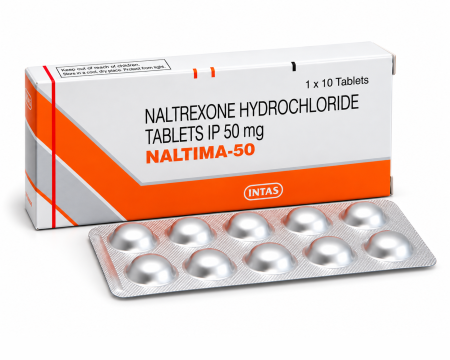
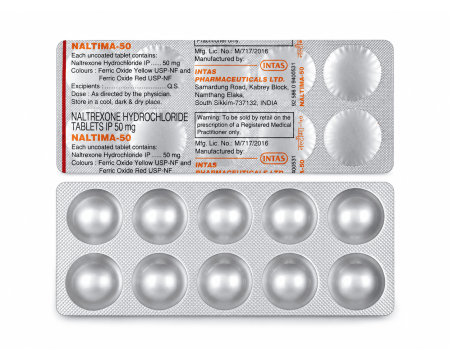


Drug Info
- Brand Name: Revia
- Active Ingredient: Naltrexone Hydrochloride
- Manufacturer: Teva Pharmaceuticals
Active substance Naltrexone Hydrochloride
Naltrexone selectively and competitively binds μ-opioid receptors (with activity at κ and δ as well), preventing receptor activation by opioids. In alcohol use disorder, its clinical effect is associated with attenuation of mesolimbic dopaminergic responses to alcohol, which can reduce craving and the likelihood of heavy-drinking days. Because naltrexone has no intrinsic opioid agonist activity, it does not produce euphoria, tolerance, or physical dependence.
After oral administration, naltrexone hydrochloride is well absorbed and undergoes first-pass metabolism to 6-β-naltrexol, an active metabolite. The parent compound has a relatively short plasma half-life, while receptor blockade persists beyond plasma clearance due to high-affinity binding and metabolite contribution. Once-daily dosing is usually sufficient. Hepatic metabolism and renal excretion of metabolites mean that active liver disease requires caution and monitoring. Naltrexone does not meaningfully interact with cytochrome P450 pathways and has a low potential for pharmacokinetic drug–drug interactions, but pharmacodynamic interactions with opioids are central to safe use (see Interactions).
Indications for use
- Alcohol use disorder (AUD): reduction of relapse risk and heavy-drinking days as part of a comprehensive treatment program
- Opioid use disorder (OUD): maintenance of opioid abstinence after detoxification and confirmation of opioid-free status
Use is determined by the prescriber in accordance with local labeling and an individualized treatment plan.
Treatment regimens and dosages
Use Revia exactly as prescribed. Representative adult oral schedules include:
- Standard daily regimen: 50 mg once daily with or without food. Some patients benefit from taking with food to reduce nausea.
- Alternative supervised regimens (prescriber-directed): total 350 mg/week, e.g., 100 mg on Monday, 100 mg on Wednesday, 150 mg on Friday, to support observed dosing and adherence.
- Initiation: many clinicians begin with 25 mg once, observe for tolerability/withdrawal, then increase to 50 mg once daily from the next day.
General rules:
- Confirm opioid-free status (history, urine test, or challenge) before the first dose.
- Do not use if you require ongoing opioid analgesics. If elective surgery is planned, coordinate with your clinician in advance to discuss temporary discontinuation and postoperative pain strategy.
- Do not attempt to “override” the blockade with high-dose opioids—this is dangerous and may lead to fatal overdose if the blockade wanes.
- Continue psychosocial therapy; medication works best within a structured program and regular follow-up.
Recommendations for use
Take Revia at the same time each day to reinforce habit formation. If nausea occurs early, taking with food or in the evening may help. Maintain alcohol-reduction goals with written plans (triggers, coping strategies, support contacts). Keep a brief diary of dose times, cravings (0–10 scale), alcohol-free days, and any adverse effects; share this with your clinician to guide adjustments. Carry a wallet card or wear a medical ID indicating opioid antagonist therapy so emergency teams can plan non-opioid analgesia first (e.g., regional anesthesia, acetaminophen/NSAIDs where appropriate, ketamine, α-2 agonists).
Missed Dose
If you miss a dose, take it when remembered unless it is close to the next scheduled dose. Do not take two doses at once. Resume the regular schedule. If several doses are missed and cravings increase, contact your clinician promptly.
Precautions
- Opioid dependence or recent opioid use: risk of precipitated withdrawal. Confirm opioid-free status before initiation.
- Hepatic safety: avoid use in acute hepatitis or liver failure. Monitor liver enzymes during therapy; seek evaluation for right-upper-quadrant pain, dark urine, or jaundice.
- Opioid analgesia: Revia blocks opioid analgesics. In emergencies, clinicians may use non-opioid modalities or carefully monitored higher-potency opioids once naltrexone effect diminishes.
- Depression/suicidality: monitor mood; report significant changes immediately.
- Allergy: contraindicated in hypersensitivity to naltrexone or tablet excipients.
- Pregnancy and lactation: see next section; decisions are individualized.
- Driving and hazardous tasks: Revia is generally not sedating, but alcohol withdrawal, sleep changes, or concomitant medicines may affect alertness.
Use during pregnancy
Treatment decisions during pregnancy are individualized and balance maternal benefit (reduced relapse risk) against potential fetal considerations. If you are pregnant, planning pregnancy, or become pregnant during therapy, inform your clinician to review options. Naltrexone may be present in breast milk; breastfeeding decisions require case-by-case evaluation and infant monitoring.
Possible side effects
- Common: nausea, abdominal discomfort, decreased appetite, headache, dizziness, fatigue, insomnia, anxiety or irritability, musculoskeletal aches.
- Less common: rash or pruritus, increased liver enzymes, dry mouth.
- Serious—seek medical attention: signs of liver injury (jaundice, dark urine, persistent nausea), severe allergic reaction (facial swelling, wheeze, widespread rash), severe mood changes or suicidality.
If adverse effects occur, note timing relative to dosing and alcohol exposure; this helps clinicians adjust the plan (e.g., dosing time, supportive measures).
Naltrexone: interaction with other drugs
- Opioid analgesics, opioid cough/antidiarrheal products (e.g., codeine, hydrocodone, loperamide in high misuse doses): therapeutic effects will be blocked; concurrent use can precipitate withdrawal in opioid-dependent individuals.
- Opioid antagonists/partial agonists (e.g., buprenorphine, methadone): pharmacodynamic conflict—do not combine outside specialist protocols.
- Hepatotoxic agents (e.g., high-dose acetaminophen, isoniazid): potential additive liver risk—monitor per prescriber guidance.
- CNS-active drugs (antidepressants, anxiolytics): no major PK interaction expected; monitor clinical status as mood and sleep may change during recovery.
Always provide your clinician with a complete list of prescription/OTC medicines, vitamins, and herbal supplements.
Analogs & Generics
Same active ingredient (naltrexone — international examples)
- Depade (naltrexone tablets) — brand alternative in some markets
- Naltrexone tablets (Teva) — 50 mg presentations for once-daily dosing
- Naltrexone tablets (Sandoz/Hexal) — standard strengths
- Naltrexone tablets (Accord/Actavis) — region-specific packs
- Naltrexone tablets (Viatris/Mylan) — widely used generic lines
Drug analogs (different active ingredient, same purpose — relapse prevention/maintenance)
- Extended-release naltrexone injection (monthly IM formulation) — same active substance, different dosage form for supervised administration
- Acamprosate — alcohol use disorder maintenance (glutamatergic modulation)
- Disulfiram — alcohol aversion therapy (requires high adherence and supervision)
- Buprenorphine/naloxone — opioid use disorder maintenance (partial agonist strategy)
- Methadone — opioid use disorder maintenance (full agonist strategy within licensed programs)
Storage
Store at 15–25°C in a dry place, away from direct heat and sunlight. Keep tablets in the original packaging and out of the reach of children. Do not use after the expiry date printed on the pack.
Customer Experience – What to Expect
Many patients report a gradual reduction in craving and decreased frequency of heavy-drinking or opioid-seeking urges over the first 1–2 weeks, with further stabilization by 4–6 weeks as routines and supports take hold. Mild nausea or headache may occur initially and often improves with food-time dosing or evening administration. Carrying a medical ID and sharing a written coping plan (triggers, alternatives, contacts) with family or support persons improves confidence and safety. Regular follow-ups help fine-tune goals, review liver tests when indicated, and sustain motivation throughout recovery.
FAQ
How long must I be opioid-free before starting Revia?
Typically 7–10 days, confirmed by history, urine testing, or a supervised challenge per clinician judgment.
Will Revia make me sick if I drink alcohol?
No. It is not an aversive drug like disulfiram. It reduces alcohol reward and cravings but does not cause flushing or sickness when alcohol is consumed.
Can I use opioid painkillers while on Revia?
Revia blocks opioids. For planned procedures, coordinate with your clinician well in advance. In emergencies, inform providers you take naltrexone so they can prioritize non-opioid pain strategies.
Do I need liver monitoring?
Baseline and periodic liver function tests are commonly used. Report symptoms such as dark urine, jaundice, or persistent abdominal pain.
What if I feel more anxious or have trouble sleeping?
These effects can occur early. Discuss timing (morning vs evening), sleep hygiene, and whether short-term adjustments are appropriate.
What happens if I miss doses?
Do not double up. Resume your regular schedule and contact your clinician if cravings return or adherence becomes difficult.
The best offer for Revia online on the market
Right now you can buy Revia in our online pharmacy. If you are looking for the best place to order Revia or other medicines containing naltrexone hydrochloride, then you have come to the right place.
Advantages of our pharmacy:
- Confidentiality. Most people prefer to keep addiction-treatment plans private. By ordering Revia online, you avoid unnecessary face-to-face discussions.
- Price. Buying Revia online is more beneficial than purchasing at a clinic or local pharmacy.
- Quantity. Doctors often issue a prescription for one or two packs. Our pharmacy allows you to buy the required number of Revia packs to ensure an adequate supply.
- Convenience. You make a purchase at a convenient time for you, without sacrificing service or security. You do not need to make an appointment or visit a clinic.
- Information. On our website, you can find details on dosage, side effects, safe use, and other information necessary for treatment.
We work hard to provide the best possible customer service and to ensure that our medications help reduce cravings and support sustained recovery under medical supervision.









