



Drug Info
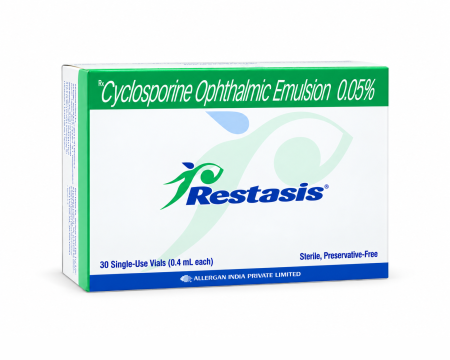
- Brand Name: Restasis
- Active Ingredient: Cyclosporine Ophthalmic Emulsion
- Manufacturer: Allergan
Active substance Cyclosporine
Cyclosporine is a calcineurin inhibitor that suppresses T-cell activation and downstream cytokine release on the ocular surface and in associated glands. In dry eye disease, this immunomodulatory effect reduces inflammation in the lacrimal functional unit, enabling recovery of basal tear secretion and promoting a healthier tear film with improved stability and osmolar balance. Unlike lubricants that merely supplement moisture, cyclosporine addresses a pathophysiologic driver of disease.
Topical ophthalmic administration produces low systemic exposure. The emulsion vehicle improves retention time and contact with the ocular surface. Because the product is preservative-free, it is suitable for long-term use in many sensitive eyes when used as directed. Transient burning or stinging upon instillation is common during the first weeks; adherence usually improves as patients learn techniques that reduce discomfort (see Recommendations).
Indications for use
- Increase of tear production in chronic dry eye disease where ocular inflammation is presumed to play a role, as determined by a clinician
- Support of ocular surface rehabilitation in comprehensive dry eye management (per prescriber judgment)
Use is determined by the prescriber according to local labeling and individual clinical assessment.
Treatment regimens and dosages
Use Restasis exactly as prescribed.
- Standard regimen: instill 1 drop in each eye twice daily, approximately 12 hours apart (morning and evening).
- Contact lenses: remove contact lenses before instillation and wait at least 15 minutes before reinsertion.
- Other eye medicines: if you use artificial tears or other ophthalmic products, separate doses by ≥15 minutes; apply Restasis after unpreserved tears when possible to maximize contact time.
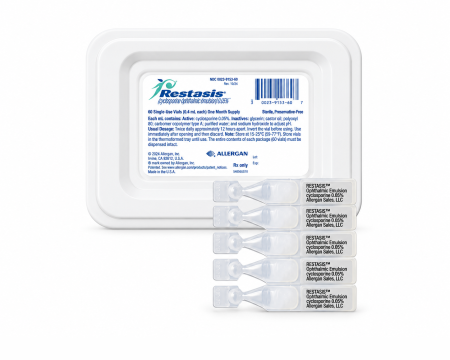
Administration technique (single-use vials):
- Wash and dry hands.
- Twist off the cap from a new single-use vial.
- Tilt head back, gently pull down the lower eyelid, and instill one drop into the conjunctival sac without touching the eye or lashes.
- Discard the vial immediately after use, even if liquid remains (to avoid contamination).
MultiDose bottle (if prescribed): avoid touching the tip; recap tightly.
When benefits appear: response is gradual; some patients notice symptom relief in several weeks, with fuller effect over 3–6 months of continuous, twice-daily dosing. Do not stop early because symptoms persist initially—discuss with your clinician.
Recommendations for use
- Keep a consistent schedule (e.g., 8:00 and 20:00). Phone alarms or a dosing chart help adherence.
- If initial burning occurs, chill the (sealed) single-use vial for a few minutes before use or apply a lubricating drop 5–10 minutes before Restasis (if recommended by your clinician).
- Manage environment: reduce direct airflow from fans/vents, maintain indoor humidity, schedule screen breaks to normalize blink rate, and use wrap-around glasses outdoors on windy days.
- Practice lid hygiene if meibomian gland dysfunction is present (warm compresses, gentle lid massage/cleansing as instructed).
- Do not touch the vial/bottle tip to the eye or any surface. Avoid using while wearing contact lenses.
- Record symptoms (burning, dryness, blur episodes), artificial tear use, and any adverse effects; this helps your clinician fine-tune the plan.
Missed Dose
If a dose is missed, instill it when remembered unless it is close to the next scheduled dose. Do not instill extra drops to compensate. Resume the regular twice-daily schedule.
Precautions
- Ocular infection: do not use during an active eye infection. Contact your clinician promptly for new eye pain, marked redness, purulent discharge, or sudden vision changes.
- Hypersensitivity: discontinue and seek care for signs of allergy (eyelid/ocular swelling, rash, wheeze).
- Driving and tasks requiring clear vision: transient blurred vision may occur immediately after instillation; wait until vision clears.
- Contact lenses: remove before dosing; wait ≥15 minutes before reinsertion.
- Pediatric/geriatric use: follow regional labeling; tolerability is generally good when used as directed.
- Systemic conditions/medicines: systemic exposure is low, but inform your clinician about autoimmune disease, recent ocular surgery, or concurrent topical therapies.
Use during pregnancy
Decisions are individualized. Systemic absorption from topical ocular use is low; your clinician will weigh maternal benefit against potential fetal considerations. If you are pregnant, planning pregnancy, or become pregnant during therapy, discuss options. Breastfeeding decisions should be made with medical guidance; monitor infants for unexpected effects.
Possible side effects
- Common: transient ocular burning or stinging upon instillation, eye redness, tearing, discharge, foreign-body sensation, transient blurred vision, pruritus.
- Less common: eyelid edema, eye pain, photophobia, headache.
- Serious (seek medical attention): signs of infection, persistent severe pain, marked vision changes, hypersensitivity reactions.
If adverse effects occur, note their timing relative to dosing and discuss with your clinician. Techniques such as spacing lubricants, adjusting the instillation method, or brief cooling of vials may improve comfort.
Cyclosporine (ophthalmic): interaction with other drugs
- Other ophthalmic products (drops/gels/ointments): separate administration by ≥15 minutes; apply ointments last to avoid blocking absorption.
- Contact lens solutions: no direct interaction, but avoid dosing while lenses are in place.
- Systemic immunosuppressants: clinically meaningful PK interactions are unlikely from ocular cyclosporine; your clinician will consider the overall immune profile.
Always provide a complete list of prescription/OTC medicines and eye products to your clinician.
Analogs & Generics
Same active ingredient (cyclosporine — international examples)
- Ikervis (cyclosporine 0.1% eye drops, emulsion) — once-daily formulation used in some regions
- Cyclosporine ophthalmic emulsion 0.05% (various manufacturers) — preservative-free single-use presentations
- Restasis MultiDose (cyclosporine 0.05%) — multidose, preservative-free bottle with unidirectional valve
- Cequa (cyclosporine 0.09% ophthalmic solution) — nanomicellar formulation used in some markets
- Ciclosporin eye drops (regional labels) — strengths and vehicles vary by market
Drug analogs (different active ingredient, same purpose — anti-inflammatory or tear-restoring dry eye therapy)
- Lifitegrast (e.g., Xiidra) — lymphocyte function-associated antigen-1 (LFA-1) antagonist
- Loteprednol etabonate (short-course corticosteroid; e.g., Eysuvis) — for acute flares under medical supervision
- Perfluorohexyloctane (e.g., Miebo) — tear-film lipid layer support for evaporative dry eye
- Autologous serum eye drops — specialist option for severe ocular surface disease
- Sodium hyaluronate or carboxymethylcellulose lubricants — symptomatic relief (adjuncts; not anti-inflammatory)
Storage
Store single-use vials or MultiDose bottle at 15–25°C (check carton for regional limits). Protect from freezing and excessive heat. Keep in the original packaging to shield from light and contamination. Discard opened single-use vials immediately after instillation. Keep out of the reach of children.
Customer Experience – What to Expect
Many patients report that the stinging sensation at instillation diminishes after the first 1–2 weeks as technique improves and the ocular surface stabilizes. Symptom relief (less burning, less need for artificial tears, more comfortable screen time) often becomes noticeable after several weeks, with more consistent benefits by 3–6 months of uninterrupted twice-daily use. Combining Restasis with environmental measures, lubricants (spaced appropriately), and lid hygiene for meibomian dysfunction typically enhances comfort. Keeping a brief diary of daily dosing, artificial tear frequency, screen hours, and symptom ratings helps your clinician optimize the plan and set realistic milestones.
FAQ
How soon will Restasis start working?
Some patients notice early improvement within weeks, but the full effect often requires 3–6 months of regular use.
Can I keep using artificial tears?
Yes. Use unpreserved tears if possible and separate by ≥15 minutes from Restasis.
What if it burns when I put it in?
A brief stinging is common. Chilling the sealed vial for a few minutes or instilling a lubricant 5–10 minutes before may help. If pain is severe or persistent, contact your clinician.
Can I wear contact lenses?
Remove lenses before dosing and wait at least 15 minutes before reinserting.
What if I miss a dose?
Instill it when remembered unless near the next dose. Do not double doses.
Is it safe with my other eye medicines?
Usually yes, with ≥15 minutes between products. Apply ointments last. Always share your full medication list with your clinician.
The best offer for Restasis online on the market
Right now you can buy Restasis in our online pharmacy. If you are looking for the best place to order Restasis or other medicines containing cyclosporine for chronic dry eye, then you have come to the right place.
Advantages of our pharmacy:
- Confidentiality. Most people prefer to keep eye treatment private. By ordering Restasis online, you avoid unnecessary face-to-face discussions.
- Price. Buying Restasis online is more beneficial than purchasing at a clinic or local pharmacy.
- Quantity. Doctors often issue a prescription for one or two packs. Our pharmacy allows you to buy the required number of Restasis packs to ensure an adequate supply.
- Convenience. You make a purchase at a convenient time for you, without sacrificing service or security. You do not need to make an appointment or visit a clinic.
- Information. On our website, you can find details on dosage, side effects, safe use, and other information necessary for treatment.
We work hard to provide the best possible customer service and to ensure that our medications help restore comfortable, stable tear production under medical supervision.









