

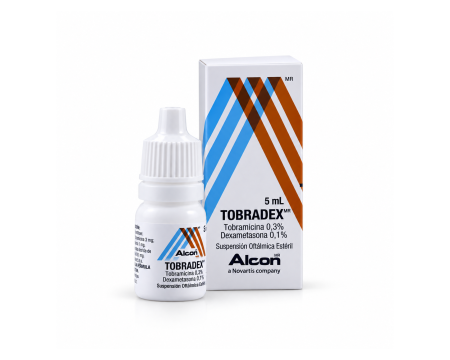


Drug Info
- Brand Name: Tobradex
- Active Ingredients: Tobramycin + Dexamethasone
- Manufacturer: Alcon
Tobradex eye drops and their active substances: Tobramycin + Dexamethasone
Tobramycin is an aminoglycoside antibiotic active against many Gram-negative organisms (e.g., Pseudomonas aeruginosa) and selected Gram-positive bacteria (e.g., Staphylococcus aureus). By binding the 30S ribosomal subunit, it disrupts protein synthesis and inhibits bacterial growth at the ocular surface. Topical administration achieves high local concentrations with minimal systemic exposure.
Dexamethasone is a potent glucocorticoid that suppresses inflammatory mediators, reduces capillary permeability, and stabilizes cellular membranes. In the eye, this translates into less conjunctival injection, edema, and cellular infiltration, helping relieve pain and photophobia and protecting tissue during healing.
Because corticosteroids can mask infection or elevate intraocular pressure (IOP) with prolonged use, Tobradex should be used exactly as prescribed, for the shortest effective duration, with clinical follow-up—especially if treatment extends beyond a brief course.
Indications for use
Use is determined by the prescriber according to regional labeling and individual assessment. Common scenarios include:
- Bacterial conjunctivitis/blepharoconjunctivitis with significant inflammatory signs
- Blepharitis with suspected bacterial contribution
- Keratitis (superficial, non-viral) where steroid response is expected and bacterial involvement is present or likely
- Post-operative ocular inflammation with risk of bacterial contamination (specialist-directed)
Tobradex is not indicated for viral eye disease (e.g., herpes simplex epithelial keratitis with dendritic lesions, varicella), mycobacterial, or fungal infections.
Treatment regimens and dosages
Use Tobradex exactly as prescribed. The clinician may combine suspension by day and ointment at night.
Suspension (drops):
- Typical regimen: instill 1–2 drops in the affected eye(s) every 4–6 hours.
- Severe cases (first 24–48 h): dosing may be increased to every 2 hours, then reduce to every 4–6 hours as the eye improves.
- Tapering: when inflammation subsides, clinicians usually taper dosing to prevent rebound.
Ointment:
- Apply a ~1 cm (¼-inch) ribbon into the conjunctival sac of the affected eye(s) 3–4 times daily or at bedtime as an adjunct to drops.
Maximum duration and review: prolonged steroid use raises risks (↑IOP, cataract, delayed healing). Do not continue beyond 7–10 days without re-examination, which may include IOP measurement and slit-lamp assessment.
Administration technique (key points):
- Shake the suspension well before each use.
- Wash hands; tilt head back; pull down lower lid to form a pocket; instill drops without touching the dropper tip; close eye gently for 1–2 minutes.
- If using multiple ophthalmic products, separate by 5–10 minutes (drops before ointment).
- Do not wear contact lenses during active infection or while using Tobradex unless your clinician explicitly allows it.
Recommendations for use
- Keep a simple daily log of dose times and symptoms (redness, pain, discharge, light sensitivity). Improvement is often noted within 48–72 hours; continue exactly as directed to complete the course.
- Maintain eyelid hygiene (warm compresses, gentle cleansing) if blepharitis contributes to symptoms.
- Protect the eye from dust, smoke, and wind; avoid sharing towels or cosmetics.
- Seek prompt advice if symptoms worsen, vision declines, or pain becomes severe.
Missed Dose
Instill the missed dose when remembered the same day. If it is near the next scheduled dose, skip the missed one. Do not apply a double dose.
Precautions
- Ocular steroid risks: prolonged or high-frequency dosing can increase IOP, precipitate or worsen glaucoma, delay corneal healing, and, with long use, contribute to posterior subcapsular cataract. Regular review is essential for extended courses.
- Infection considerations: steroids can mask or worsen infection. Contraindicated in herpetic epithelial keratitis, vaccinia/varicella, mycobacterial or fungal eye disease. Suspect fungal keratitis if ulcer persists.
- Corneal/scleral thinning: risk of perforation with steroids—use with extreme caution in thinning diseases or after ocular surgery/trauma (specialist follow-up).
- Contact lenses: avoid during active infection/therapy. Preservatives (e.g., benzalkonium chloride) can discolor soft lenses and irritate the eye.
- Driving/operating machinery: temporary blurred vision may occur after application—wait until vision clears.
- Children, pregnant or breastfeeding patients: use only if potential benefit justifies risk; systemic exposure is low but decisions are individualized.
Possible side effects
- Common (usually transient): mild burning/stinging on instillation, ocular irritation, tearing, blurred vision, foreign-body sensation, eyelid itching.
- Less common: taste disturbance after drops, dry eye, eyelid edema, photophobia.
- With longer or intensive use: elevated IOP, glaucoma, delayed epithelial healing, steroid-induced cataract, secondary infection (including fungal), corneal thinning.
- Serious—seek care: strong eye pain, marked vision changes, persistent corneal defect, pronounced swelling, rash or facial swelling suggestive of allergy.
Tobramycin + Dexamethasone: interaction with other drugs
Systemic interactions are rare with topical ophthalmic use. Consider:
- Other ocular steroids/NSAIDs: additive risk of delayed healing and ↑IOP—use only as directed.
- P-gp/CYP affecting systemic medicines: clinically minimal at ophthalmic doses; inform your clinician about all medicines.
- Soft contact lenses: preservatives interact with lenses—remove lenses and wait 15 minutes after dosing if your clinician allows lens wear later in therapy.
Analogs & Generics
Same active ingredients (international examples)
- Tobramycin/Dexamethasone ophthalmic suspension 0.3%/0.1% (various generics)
- Tobramycin/Dexamethasone ophthalmic ointment 0.3%/0.1% (regional availability)
- TobraDex ST (tobramycin 0.3% + dexamethasone 0.05%) — thicker suspension designed for longer surface contact (market-dependent)
Drug analogs (different active ingredient, same therapeutic purpose—chosen by cause and clinician plan)
- Zylet (tobramycin + loteprednol 0.5%) — antibiotic + corticosteroid combination
- Maxitrol (neomycin + polymyxin B + dexamethasone) — combination drop/ointment
- Blephamide (sulfacetamide + prednisolone) — antibiotic + steroid
- Monotherapy alternatives when steroid not required: Tobramycin 0.3%, Moxifloxacin 0.5%, Ofloxacin 0.3%, Chloramphenicol 0.5% (selection guided by local patterns and diagnosis)
Storage
Store at 15–25°C protected from light. Do not freeze. Keep the bottle/tube tightly closed and avoid contaminating the tip. Keep out of reach of children. Discard opened bottles/tubes after 4 weeks (or per label instructions) to reduce contamination risk.
Customer Experience – What to Expect
Many patients report less redness, grit sensation, and discharge within 48–72 hours, with steady recovery as dosing tapers. A brief stinging or blur right after instillation is common and passes quickly. Using the ointment at bedtime can improve morning comfort. If there is no improvement after 2–3 days, or if pain/vision worsens, re-evaluation is important to exclude non-bacterial or steroid-sensitive conditions.
FAQ
Can I wear contact lenses while using Tobradex?
No—avoid lenses during active infection and treatment. Resume only when your clinician confirms it is safe.
How should I space multiple eye medications?
Wait 5–10 minutes between products; apply drops before ointment.
Do I need to finish the course if I feel better?
Yes—follow the full prescribed plan and taper as directed to prevent rebound inflammation.
Is Tobradex effective for viral “pink eye”?
No. It is not indicated for viral conjunctivitis (e.g., adenovirus or herpes simplex epithelial disease).
What if a drop misses the eye?
Instill another drop. Try to keep the tip clean; do not touch the eye or lashes.
Can it increase eye pressure?
With prolonged use, steroids may raise IOP. This is why longer courses require clinical monitoring.
The best offer for Tobradex online on the market
Right now you can buy Tobradex in our online pharmacy. If you are looking for the best place to order Tobradex or other ophthalmic medicines combining tobramycin with a corticosteroid, then you have come to the right place.
Advantages of our pharmacy:
- Confidentiality. Most people prefer to keep eye treatment private. By ordering Tobradex online, you avoid unnecessary face-to-face discussions.
- Price. Buying Tobradex online is more beneficial than purchasing at a clinic or local pharmacy.
- Quantity. Doctors often issue a prescription for one or two packs. Our pharmacy allows you to buy the required number of Tobradex units to ensure an adequate supply for the full course.
- Convenience. You make a purchase at a convenient time for you, without sacrificing service or security. You do not need to make an appointment or visit a clinic.
- Information. On our website, you can find details on dosage, side effects, safe use, and other information necessary for treatment.
We work hard to provide the best possible customer service and to ensure that our medications help resolve bacterial eye infections with inflammation safely and effectively under medical supervision.









