

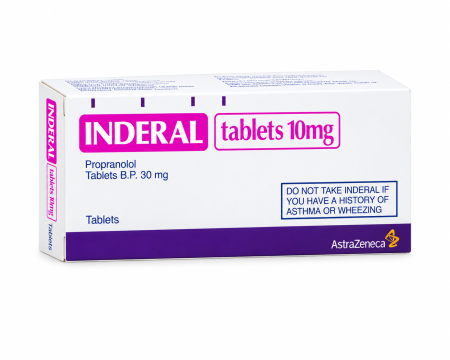
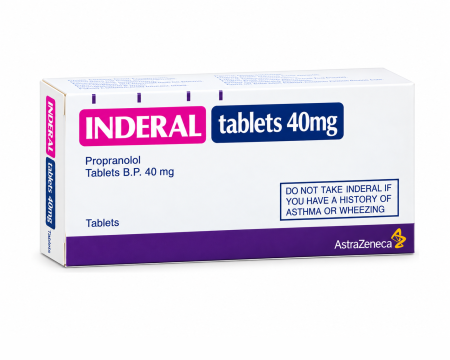


Drug Info
- Brand Name: Inderal
- Active Ingredient: Propranolol Hydrochloride
- Manufacturer: AstraZeneca
Active substance: Propranolol Hydrochloride
Propranolol competitively blocks β1- and β2-adrenoceptors. Cardiac effects include decreased sinus rate, slowed AV conduction, and reduced contractility; renal β1 blockade reduces renin release. Peripheral β2 blockade lessens tremor amplitude and may contribute to migraine prophylaxis through effects on vascular tone and central noradrenergic pathways.
The drug is lipophilic, crosses the blood–brain barrier, and undergoes extensive first-pass hepatic metabolism; exposure varies among individuals. Food can increase bioavailability modestly; taking IR doses at consistent times relative to meals supports steady response. Propranolol’s half-life is short (IR), but ER formulations provide controlled release for 24-hour coverage. Because it is primarily hepatically cleared, caution is needed in liver impairment; dose adjustment may be required in frailty or with strong enzyme inducers/inhibitors. Non-selective β2 blockade means bronchospasm can occur in susceptible individuals—Inderal is contraindicated in asthma and should be used with caution in COPD.
Indications for use
Prescriber-directed uses vary by region and labeling. Common indications include:
- Hypertension (alone or with other antihypertensives)
- Angina pectoris (to reduce frequency of effort-related chest pain)
- Rate control in supraventricular tachycardias (including atrial fibrillation/flutter)
- Migraine prophylaxis (prevention of attacks)
- Essential tremor (symptomatic control)
- Hypertrophic subaortic stenosis (symptom control)
- Pheochromocytoma (adjunct) — only after adequate α-blockade and under specialist care
Use is determined by the clinician according to local guidelines and individual assessment.
Treatment regimens and dosages
Use Inderal exactly as prescribed. Representative adult schedules (the prescriber will tailor doses and targets):
- Hypertension (IR): start 40 mg twice daily, then increase every 1–2 weeks to 80–160 mg twice daily (typical total 160–320 mg/day).
Hypertension (ER): 80 mg once daily, titrate to 120–160 mg once daily (some patients require up to 320 mg/day). - Angina pectoris (IR): 40–80 mg two to three times daily; typical total 120–240 mg/day.
Angina (ER): 80–160 mg once daily, titrate to response. - Rate control in SVT/AF: 10–40 mg three to four times daily (IR) or 80–160 mg once daily (ER) per heart-rate targets and tolerability.
- Migraine prophylaxis: 40 mg twice daily (IR); increase stepwise to 80 mg twice daily (some need up to 160–240 mg/day). ER alternatives (e.g., 80–160 mg once daily) may improve adherence.
- Essential tremor: 40 mg twice daily (IR); titrate to 120–320 mg/day in divided doses based on tremor reduction and tolerability.
- Performance-related situational anxiety (prescriber-directed): 10–40 mg IR, 30–60 minutes before the event; not a chronic regimen.
General rules: take IR tablets in divided doses at consistent times; ER capsules once daily (swallow whole). Do not stop suddenly—taper over 1–2 weeks unless urgent clinical reasons dictate otherwise. In renal impairment, dose adjustment is usually not required; in hepatic impairment, lower initial doses and careful titration are advised.
Recommendations for use
- Track resting and activity heart rate and blood pressure during titration.
- If dizziness or fatigue appears, review dose timing and avoid rapid posture changes.
- Diabetics: Inderal may mask adrenergic symptoms of hypoglycemia (e.g., tremor); maintain regular glucose checks and recognize alternative signs (sweating).
- For migraine: combine with trigger management (regular meals, hydration, sleep hygiene).
- For tremor: limit caffeine/stimulants; note stepwise dose–response.
- Avoid alcohol excess; it can potentiate hypotension and sedation.
Missed Dose
Take the missed dose when remembered unless it is near the next dose. Do not double the next dose. Resume your usual schedule. If multiple doses are missed—especially in angina—contact your clinician for advice on a safe restart.
Precautions
- Respiratory: contraindicated in asthma or history of bronchospasm; use caution in COPD.
- Cardiac conduction/contractility: avoid in severe bradycardia, 2nd/3rd-degree AV block, sick sinus syndrome (without pacemaker), cardiogenic shock, or decompensated heart failure; use cautiously in controlled heart failure.
- Peripheral circulation: may worsen Raynaud’s phenomenon or severe peripheral arterial disease.
- Metabolic: masks hypoglycemia signs; may affect lipid profile (↑TG, ↓HDL) in some patients.
- Thyrotoxicosis: can mask tachycardia—do not withdraw abruptly.
- Anaphylaxis: β-blockers may reduce responsiveness to epinephrine.
- Surgery: anesthetist must know you are on a β-blocker; perioperative plans are individualized.
- Pregnancy/lactation: see below.
- Driving/hazardous tasks: assess individual response—dizziness and fatigue can occur.
Use during pregnancy
Decisions are individualized. Propranolol has been used when benefits outweigh risks (e.g., specific arrhythmias). Potential fetal/neonatal effects include growth restriction, bradycardia, hypoglycemia. If used in late pregnancy, neonatal monitoring is advised. Small amounts pass into breast milk; breastfeeding decisions require clinician guidance with infant observation for bradycardia or poor feeding.
Possible side effects
- Common: bradycardia, cold extremities, fatigue, dizziness, sleep disturbance or vivid dreams, GI upset (nausea, diarrhea).
- Less common: depression or mood change, rash, impotence, bronchospasm (especially in reactive airway disease), hypotension.
- Serious—seek care: syncope, severe shortness of breath, new/worsening chest pain, extreme bradycardia, wheezing in non-asthmatics, signs of heart block.
Document timing, dose relation, and concurrent factors (caffeine, exertion); this helps clinicians adjust dosing or consider alternatives.
Propranolol: interaction with other drugs
- Non-dihydropyridine CCBs (verapamil, diltiazem): risk of bradycardia/AV block/heart failure—avoid IV combinations; oral combinations require specialist oversight.
- Other rate-/BP-lowering agents (digoxin, amiodarone, clonidine, antihypertensives): additive effects; if stopping clonidine, taper propranolol first to reduce rebound risk.
- CYP1A2/2D6 modulators: inhibitors (e.g., fluvoxamine, paroxetine, quinidine) may raise levels; inducers (e.g., smoking, rifampin) may lower levels—dose review may be needed.
- NSAIDs: may reduce antihypertensive effect; monitor BP.
- Hypoglycemics/insulin: altered hypoglycemia awareness—tight glucose monitoring.
- Anesthetics and alcohol: additive hypotension/CNS effects.
Always provide a complete list of prescription/OTC medicines and supplements to your clinician.
Analogs & Generics
Same active ingredient (propranolol — international examples)
- Propranolol IR tablets (Teva, Sandoz/Hexal, Accord/Actavis, Viatris/Mylan) — 10 mg, 40 mg, 80 mg
- Inderal LA / Propranolol ER (various manufacturers) — 60 mg, 80 mg, 120 mg, 160 mg once daily
- Propranolol oral solution (market-dependent) — titration or pediatric needs
Drug analogs (different active ingredient, same therapeutic purpose — examples)
- Hypertension/angina/arrhythmia: Metoprolol, Bisoprolol, Atenolol, Carvedilol, Nebivolol
- Migraine prophylaxis: Metoprolol, Timolol, Topiramate, Amitriptyline (per clinician judgment)
- Essential tremor: Primidone, Topiramate (alternatives/adjuncts where suitable)
Storage
Store at 15–25°C in a dry place away from heat and light. Keep in the original packaging and out of the reach of children. Do not use after the expiry date on the pack.
Customer Experience – What to Expect
For hypertension and angina, many patients notice steadier heart rate and fewer exertional symptoms within 1–2 weeks, with additional gains as the dose is optimized. In migraine prevention, benefits build gradually over 4–8 weeks; attack frequency and intensity decline when taken consistently. With essential tremor, improvement is often perceptible at the first effective dose and refines with careful titration. Early fatigue or cold hands/feet commonly settle after dose timing adjustments. Keeping a simple diary (heart rate/BP, angina episodes, migraine days, tremor severity, side effects) supports precise titration and shared decisions.
FAQ
How fast does Inderal start to work?
Heart-rate and blood-pressure effects appear within hours of dosing; clinical benefits (e.g., fewer angina episodes, migraine prevention) accrue over days to weeks.
Can I take Inderal if I have asthma?
No—Inderal is contraindicated in asthma due to bronchospasm risk. Discuss alternatives.
What happens if I stop suddenly?
Abrupt withdrawal can cause rebound tachycardia, hypertension, or angina. Taper gradually under medical supervision.
Does it affect blood sugar awareness?
Yes—Inderal may mask hypoglycemia symptoms such as tremor. Monitor glucose regularly and learn alternative warning signs.
IR or ER—what’s better?
Both are effective. ER offers once-daily convenience and stable coverage; IR allows flexible titration. Your clinician will choose based on indication and lifestyle.
Can I use it for stage fright?
Some clinicians use small IR doses (e.g., 10–40 mg before an event). This is prescriber-directed and not a chronic regimen.
The best offer for Inderal online on the market
Right now you can buy Inderal in our online pharmacy. If you are looking for the best place to order Inderal or other medicines containing propranolol, then you have come to the right place.
Advantages of our pharmacy:
- Confidentiality. Most people prefer to keep cardiovascular or neurologic treatment private. By ordering Inderal online, you avoid unnecessary face-to-face discussions.
- Price. Buying Inderal online is more beneficial than purchasing at a clinic or local pharmacy.
- Quantity. Doctors often issue a prescription for one or two packs. Our pharmacy allows you to buy the required number of Inderal packs to ensure an adequate supply.
- Convenience. You make a purchase at a convenient time for you, without sacrificing service or security. You do not need to make an appointment or visit a clinic.
- Information. On our website, you can find details on dosage, side effects, safe use, and other information necessary for treatment.
We work hard to provide the best possible customer service and to ensure that our medications help control heart rate and blood pressure, prevent migraines, and reduce tremor under medical supervision.









