

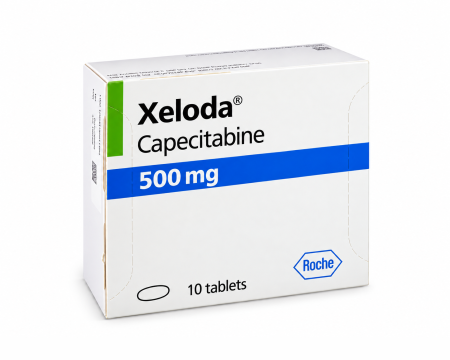


Drug Info
- Brand Name: Xeloda
- Active Ingredient: Capecitabine
- Manufacturer: Roche
Active substance Capecitabine
After oral intake, capecitabine is absorbed and sequentially converted to 5-FU through three enzymatic steps (carboxylesterase in the liver → cytidine deaminase in liver/tumor → thymidine phosphorylase enriched in tumors). 5-FU exerts cytotoxicity by inhibiting thymidylate synthase (disrupting DNA synthesis) and by misincorporation into RNA, impairing tumor cell replication.
Food slows absorption but reduces peak concentrations, which improves tolerability; therefore capecitabine is routinely taken with food. Elimination is predominantly renal as metabolites; exposure increases with renal impairment. A subset of patients has partial or complete dihydropyrimidine dehydrogenase (DPD) deficiency, which markedly raises 5-FU exposure—this is a major safety consideration (see Precautions).
Indications for use
Use is determined by the oncologist and regional labeling. Common settings include:
- Colorectal cancer: adjuvant monotherapy after surgery; metastatic disease alone or with oxaliplatin (CAPOX/XELOX) or other agents.
- Breast cancer: in combination with docetaxel after anthracycline failure, or as monotherapy when other treatments are not appropriate.
- Gastric and gastroesophageal cancers: in combinations per protocol (e.g., with platinum agents) according to regional practice.
Treatment regimens and dosages
Use Xeloda exactly as prescribed. Representative adult schedules (oncologist-directed):
- Monotherapy (e.g., colon cancer adjuvant / metastatic):
1250 mg/m² twice daily (morning and evening) for 14 days, then 7 days off (a 21-day cycle). - Combination regimens (e.g., CAPOX, with other agents):
Frequently 1000 mg/m² twice daily for 14 days, then 7 days off, adjusted to the companion drugs and protocol.
General rules:
- Take doses within 30 minutes after a meal, swallow with water.
- Do not crush or split tablets. If a caregiver handles broken tablets, they should use gloves and wash hands.
- Dose modifications are common. For grade ≥2 toxicities (diarrhea, hand-foot syndrome, mucositis, unexplained fever, severe fatigue), stop doses and contact your oncology team for instructions.
- Renal impairment: starting-dose reduction is typical when creatinine clearance is 30–50 mL/min; use is not recommended if CrCl is <30 mL/min, unless an oncologist determines otherwise with close monitoring.
- Elderly/frail patients may start at lower doses with careful escalation.
Recommendations for use
- Keep a treatment diary for dose times, bowel movements, oral intake, temperature, and symptoms (mouth soreness, hand/foot changes, rashes).
- Skin care: moisturize hands/feet twice daily; avoid hot water, tight shoes, friction. Report tingling, redness, or peeling early—prompt holds and dose adjustments prevent severe hand-foot syndrome.
- Diarrhea plan: start antidiarrheals as directed by your team at the first loose stool; increase fluids; call if ≥4 stools/day over baseline, or any stool with fever, dizziness, or cramps.
- Mouth care: soft toothbrush, bland rinses (saline/bicarbonate). Avoid spicy/acidic foods if mucositis appears.
- Hydration and nutrition: small frequent meals, adequate fluids.
- Sun protection: capecitabine can increase photosensitivity—use sunscreen and protective clothing.
- Keep all blood tests (CBC, renal/hepatic function) and clinic visits as scheduled.
Missed Dose
If a dose is missed, do not take an extra tablet to compensate. Take the next dose at the usual time and record the miss in your diary. For repeated misses or vomiting shortly after dosing, contact your care team for guidance.
Precautions
- DPD deficiency: partial or complete deficiency can cause life-threatening toxicity (severe stomatitis, neutropenia, diarrhea, neurotoxicity) even at standard doses. Many centers perform DPYD genotyping or DPD activity assessment before therapy. Inform your team of any strong early reactions in cycle 1.
- Gastrointestinal toxicity: early, persistent diarrhea warrants immediate dose hold and medical advice. Risk of dehydration, electrolyte imbalance, renal injury.
- Myelosuppression and infection: monitor blood counts. Call urgently for fever ≥38°C, chills, sore throat, or signs of infection.
- Hand-foot syndrome: redness, swelling, pain, or blistering of palms/soles—report early.
- Mucositis/stomatitis: painful mouth or throat sores—dose holds and supportive care may be needed.
- Cardiac events: chest pain, dyspnea, arrhythmia (including coronary vasospasm) have been reported with fluoropyrimidines; seek urgent care for new chest pain.
- Hepatic/biliary: hyperbilirubinemia can occur; monitor liver tests.
- Renal impairment: increased exposure—dose adjustments and close monitoring required (see Dosing).
- Anticoagulation: interactions with warfarin and other coumarins can markedly increase INR and bleeding risk—enhanced monitoring is required.
- Handling precautions: chemotherapy tablets require careful handling; keep away from children and pets.
Use during pregnancy
Capecitabine can harm an unborn baby. It is contraindicated in pregnancy. Use effective contraception during treatment and for a period after the last dose (typically 6 months for females and 3 months for males; follow your oncologist’s advice). Do not breastfeed during treatment and for a period after the final dose as advised by your clinician.
Possible side effects
- Very common/common: diarrhea, nausea, vomiting, abdominal pain, decreased appetite, hand-foot syndrome, fatigue/asthenia, mucositis/stomatitis, dermatitis/dry skin, hyperbilirubinemia, anemia, neutropenia, thrombocytopenia.
- Less common: dehydration, fever, headache, insomnia, taste changes, photosensitivity, edema, elevated liver enzymes.
- Serious—seek urgent care: persistent/watery diarrhea, uncontrolled vomiting, fever or signs of infection, chest pain, shortness of breath, sudden bleeding, confusion, severe abdominal pain, allergic reactions (facial swelling, wheeze, widespread rash), signs of dehydration (dizziness, little urine).
Capecitabine: interaction with other drugs
- Warfarin and other coumarins: can increase INR and bleeding—requires frequent INR checks and dose adjustments.
- Phenytoin: capecitabine may increase phenytoin levels—monitor and adjust.
- Folinic acid (leucovorin) / folic acid at high supplemental doses: may enhance fluoropyrimidine toxicity—use only per protocol.
- Brivudine or sorivudine (and related analogs): contraindicated—can cause fatal 5-FU toxicity by inhibiting DPD; maintain a long washout as directed by your oncologist.
- Allopurinol: may reduce 5-FU efficacy—avoid unless prescriber instructs.
- Cimetidine and some antacids: may modestly alter exposure—clinician will advise.
Always give your oncology team a complete list of prescription/OTC medicines, vitamins, and herbal products (e.g., St. John’s wort).
Analogs & Generics
Same active ingredient (capecitabine — international examples)
- Capecitabine tablets (Teva) — 150 mg, 500 mg BSA-based dosing
- Capecitabine tablets (Sandoz/Hexal) — standard strengths
- Capecitabine tablets (Accord/Actavis) — film-coated tablets
- Capecitabine tablets (Viatris/Mylan) — widely used generics
- Capecitabine tablets (Cipla/Sun/Intas/Dr. Reddy’s) — region-specific packs
Drug analogs (different active ingredient, same purpose — fluoropyrimidine/antimetabolite regimens)
- 5-Fluorouracil (5-FU) IV — continuous infusion or bolus regimens (e.g., FOLFOX/FOLFIRI backbones)
- Tegafur-uracil (UFT) — oral fluoropyrimidine (availability varies by region)
- S-1 (tegafur/gimeracil/oteracil) — oral fluoropyrimidine used in some regions for GI cancers
- Trifluridine/tipiracil (Lonsurf) — oral nucleoside analog for refractory metastatic colorectal cancer
- Raltitrexed — thymidylate synthase inhibitor used in selected colorectal indications
Storage
Store at 15–25°C in a dry place away from direct heat and sunlight. Keep tablets in the original packaging and out of the reach of children. Do not use after the expiry date on the blister/carton.
Customer Experience – What to Expect
Patients typically take Xeloda in 21-day cycles (14 days on, 7 days off). Many notice predictable timing of side effects—mild nausea or fatigue during dosing days, with improvement in the off week. Hand-foot changes (tingling, redness) and loose stools can arise in the first cycles; reporting these early allows dose holds or reductions that keep treatment on track. Appetite often fluctuates; small frequent meals and hydration help. Regular blood tests guide safe continuation. Your team will reassure you that dose reductions are common and do not necessarily reduce the chance of benefit—comfort and safety come first.
FAQ
How should I take Xeloda each day?
Twice daily, within 30 minutes after meals, about 12 hours apart. Swallow tablets whole with water.
Can I keep taking vitamins or folic acid?
Discuss with your team. High-dose folinic/folic acid can increase toxicity with fluoropyrimidines; standard multivitamins are reviewed individually.
What if I get diarrhea?
Start your prescribed antidiarrheal and hold doses if diarrhea is more than mild. Call your clinic the same day for instructions—early action prevents complications.
I’m on warfarin—what changes?
INR monitoring becomes more frequent; dose adjustments are common.
Can I work or drive during treatment?
Many people do, but assess your own energy and concentration. Avoid driving if dizzy, very fatigued, or dehydrated.
Is sun exposure a problem?
Yes, photosensitivity can occur. Use sunscreen, protective clothing, and avoid intense midday sun.
The best offer for Xeloda online on the market
Right now you can buy Xeloda in our online pharmacy. If you are looking for the best place to order Xeloda or other medicines containing capecitabine, then you have come to the right place.
Advantages of our pharmacy:
- Confidentiality. Most people prefer to keep oncology treatment private. By ordering Xeloda online, you avoid unnecessary face-to-face discussions.
- Price. Buying Xeloda online is more beneficial than purchasing at a clinic or local pharmacy.
- Quantity. Doctors often issue a prescription for one or two packs. Our pharmacy allows you to buy the required number of Xeloda packs to ensure an adequate supply.
- Convenience. You make a purchase at a convenient time for you, without sacrificing service or security. You do not need to make an appointment or visit a clinic.
- Information. On our website, you can find details on dosage, side effects, safe use, and other information necessary for treatment.
We work hard to provide the best possible customer service and to ensure that our medications support safe, effective cancer care under your oncology team’s supervision.









