


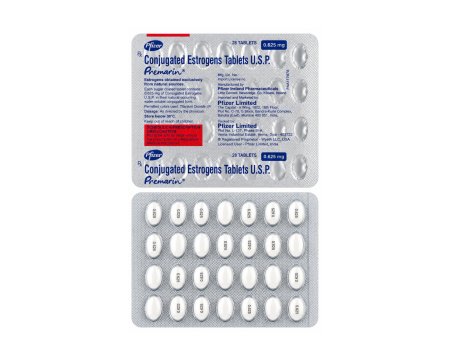


Drug Info
- Brand Name: Premarin
- Active Ingredient: Conjugated estrogens (CEE)
- Manufacturer: Pfizer Inc.
Active substance Conjugated Estrogens
Conjugated estrogens exert estrogenic effects by binding estrogen receptors (ERα/ERβ) in target tissues, modulating gene expression and non-genomic signaling. Clinically, this leads to decreased frequency and intensity of vasomotor episodes, improvement in vulvovaginal atrophy, and favorable effects on bone turnover markers that help prevent bone loss when other options are unsuitable or not tolerated.
CEE undergoes intestinal and hepatic metabolism with enterohepatic recirculation. Exposure varies with dose, formulation, and individual factors (body mass, hepatic function). Because estrogens increase thyroxine-binding globulin, patients on levothyroxine may require dose reassessment. Estrogens can also influence triglycerides and fluid balance; clinicians consider baseline cardiovascular/metabolic risk and monitor accordingly.
Tolerability is generally dose-related. Breast tenderness, headache, mild edema, or breakthrough bleeding/spotting may occur, especially during early cycles or dose changes. Adjusting the dose, schedule (continuous vs cyclic), or adding/changing the progestin often improves comfort. Any unexpected vaginal bleeding warrants prompt evaluation.
Indications for use
- Moderate to severe vasomotor symptoms due to menopause
- Moderate to severe vulvar and vaginal atrophy associated with menopause (systemic therapy may be used when local therapy is not suitable)
- Prevention of postmenopausal osteoporosis when non-estrogen therapies are inappropriate or not tolerated
- Estrogen replacement in hypoestrogenism due to primary ovarian failure, hypogonadism, or surgical castration (per prescriber judgment)
- Palliative treatment of selected hormone-responsive malignancies (e.g., advanced prostate cancer) per local labeling and specialist guidance
Use is determined by the prescriber according to local regulations and individual clinical assessment.
Treatment regimens and dosages
Use Premarin exactly as prescribed. Representative adult oral schedules include:
- Vasomotor symptoms / vulvovaginal atrophy (systemic):
Initiate at 0.3 mg once daily, titrating to 0.45–0.625 mg once daily if needed. Some patients require 0.9–1.25 mg once daily for adequate control. Dosing may be continuous daily or cyclic (e.g., 21 days on, 7 days off), as directed. - Prevention of postmenopausal osteoporosis:
Lowest effective dose (often 0.3–0.45 mg once daily), together with lifestyle measures (calcium, vitamin D, weight-bearing exercise), when non-estrogen options are unsuitable. - Hypoestrogenism states:
Dose individualized to clinical goals (e.g., development/maintenance of secondary sexual characteristics), often using cyclic regimens with a progestin if the uterus is present.
General rules:
- Women with an intact uterus typically receive a progestin for 10–14 days per month or continuously to reduce endometrial risk.
- Swallow tablets at the same time each day, with or without food.
- Reassess need, dose, and risk profile at regular intervals (e.g., every 3–6 months).
- Do not adjust or stop abruptly without medical advice.
Recommendations for use
Agree on clear treatment goals (e.g., reducing hot flashes to a tolerable level, improving sleep). Keep a brief diary of vasomotor episodes, sleep quality, urogenital symptoms, and any bleeding; this helps fine-tune the dose and regimen. Maintain bone-health habits (adequate calcium/vitamin D intake, weight-bearing exercise, smoking cessation, limited alcohol). Schedule routine breast exams and screening per regional guidelines. Report new breast changes, persistent pelvic pain, leg swelling, chest pain, severe headache, vision changes, jaundice, or any unexpected vaginal bleeding immediately.
Missed Dose
If a dose is missed, take it when remembered unless it is close to the next dose. Do not take two doses at once. Resume the regular schedule and note any breakthrough bleeding for your clinician.
Precautions
- Endometrial cancer: unopposed estrogen increases risk in women with a uterus—add a progestin as directed and investigate any unexpected bleeding.
- Breast cancer: systemic estrogen therapy may increase risk with duration; follow screening recommendations and reassess ongoing need regularly.
- Cardiovascular and thromboembolic risk: risk of stroke, deep-vein thrombosis (DVT)/pulmonary embolism (PE), and myocardial infarction increases with systemic estrogen, particularly in older age, smokers, and those with risk factors. Avoid in active/recent thromboembolism or arterial thromboembolic disease.
- Liver disease: avoid in active liver dysfunction; monitor if history of hepatic disease.
- Gallbladder disease and hypertriglyceridemia: estrogens may worsen these; monitor susceptible patients.
- Fluid retention, blood pressure, and migraine: monitor in patients with heart, kidney, or migraine disorders.
- Contraindications: known/suspected breast or estrogen-dependent neoplasia; undiagnosed vaginal bleeding; active/recent arterial thromboembolic disease (e.g., stroke, MI); active or history of DVT/PE; known thrombophilia; active liver disease; pregnancy; hypersensitivity to components.
Use during pregnancy
Premarin is contraindicated during pregnancy. If pregnancy occurs, discontinue and contact a clinician. Decisions about use during lactation are individualized; estrogens can reduce milk production—discuss risks and benefits with your prescriber.
Possible side effects
- Common: breast tenderness, headache, nausea, abdominal discomfort, bloating, mild edema, mood changes, breakthrough bleeding/spotting.
- Less common: increased blood pressure, changes in libido, leg cramps, skin changes, gallbladder symptoms.
- Serious (seek medical attention): signs of stroke (sudden weakness, speech/vision changes), chest pain, shortness of breath, leg swelling/pain (possible DVT), jaundice, severe headache or migraine aura, persistent or heavy vaginal bleeding, new breast lump.
Record timing, severity, and any triggers; this helps clinicians adjust dose/regimen or investigate further.
Conjugated estrogens: interaction with other drugs
- CYP3A4 inducers (e.g., rifampin, carbamazepine, phenytoin, St. John’s wort) may reduce estrogen exposure; CYP3A4 inhibitors (e.g., ketoconazole, clarithromycin) may increase exposure—clinical monitoring is advised.
- Thyroid replacement: estrogens increase thyroxine-binding globulin; patients on levothyroxine may need dose adjustment with TSH monitoring.
- Lamotrigine: estrogens can increase clearance and lower lamotrigine levels—monitor for loss of seizure/mood control.
- Anticoagulants/antiplatelets: estrogens may alter coagulation balance—monitor clinically if co-used.
- Corticosteroids and other binding-protein substrates: total levels may change; clinical effect guides adjustments.
Always provide a complete, up-to-date list of prescription/OTC medicines, vitamins, and herbal supplements.
Analogs & Generics
Same active ingredient (conjugated estrogens — international examples)
- Conjugated estrogens tablets (various international manufacturers) — 0.3 mg to 1.25 mg strengths
- Conjugated estrogens tablets (film-coated; region-specific labels) — standard systemic HRT doses
- Conjugated estrogens tablets (hospital/retail packs; country-dependent MAHs) — continuous or cyclic regimens per labeling
- Conjugated estrogens vaginal cream — 0.625 mg/g for local symptoms when systemic therapy is not desired
- Conjugated estrogens tablets (parallel-imported presentations) — strengths per local market
Drug analogs (different active ingredient, same purpose — menopausal HRT)
- Estradiol (oral tablets) — 0.5 mg, 1 mg; systemic HRT
- Estradiol valerate (oral) — dose-titrated systemic HRT
- Transdermal estradiol (patch/gel/spray) — systemic HRT with lower hepatic first-pass
- Vaginal estradiol (tablet/ring/cream) — local therapy for GSM
- Estradiol + progestin combinations (e.g., estradiol/levonorgestrel patch; estradiol/dydrogesterone tablets) — for women with an intact uterus
Storage
Store at 15–25°C in a dry place away from direct heat and sunlight. Keep tablets in the original packaging and out of the reach of children. Do not use after the expiry date printed on the pack.
Customer Experience – What to Expect
Many patients report a noticeable reduction in hot flashes and night sweats within 1–2 weeks, with further improvement over 4–8 weeks as the dose and regimen are optimized. Vaginal comfort and sleep quality often improve as systemic symptoms stabilize. Mild breast tenderness, spotting, or bloating can occur during early cycles and usually lessen after dose adjustments or once a progestin component is established in women with a uterus. Keep a simple diary of symptoms, any bleeding, and side effects; regular follow-ups every few months help confirm that the lowest effective dose is used and that benefits continue to outweigh risks.
FAQ
Do I need a progestin with Premarin?
If you have a uterus, a progestin is usually added for at least 10–14 days per month (or continuously) to reduce endometrial risk. Women without a uterus generally do not need a progestin.
How long will I need treatment?
Use the shortest duration that achieves goals. Your clinician will reassess every 3–6 months to consider dose reduction, switching, or discontinuation.
Will Premarin help my bones?
Systemic estrogen helps prevent bone loss; it is considered when non-estrogen options are unsuitable. Bone health also depends on calcium, vitamin D, exercise, and lifestyle.
What if I have unexpected vaginal bleeding?
Contact your clinician promptly for evaluation. Do not ignore bleeding after menopause.
Can I take Premarin with my thyroid medicine?
Possibly, but estrogen can increase thyroxine-binding globulin; your levothyroxine dose may need adjustment with TSH monitoring.
Is Premarin safe with my migraine or high blood pressure?
Estrogens can influence BP and migraines. Your clinician will weigh risks and may suggest alternative routes (e.g., transdermal estradiol) or closer monitoring.
The best offer for Premarin online on the market
Right now you can buy Premarin in our online pharmacy. If you are looking for the best place to order Premarin or other medicines containing conjugated estrogens, then you have come to the right place.
Advantages of our pharmacy:
- Confidentiality. Most people prefer to keep menopause and hormone therapy private. By ordering Premarin online, you avoid unnecessary face-to-face discussions.
- Price. Buying Premarin online is more beneficial than purchasing at a clinic or local pharmacy.
- Quantity. Doctors often issue a prescription for one or two packs. Our pharmacy allows you to buy the required number of Premarin packs to ensure an adequate supply.
- Convenience. You make a purchase at a convenient time for you, without sacrificing service or security. You do not need to make an appointment or visit a clinic.
- Information. On our website, you can find details on dosage, side effects, safe use, and other information necessary for treatment.
We work hard to provide the best possible customer service and to ensure that our medications help relieve menopausal symptoms and support long-term health under medical supervision.









